Triumph Tracker 400 (2026) – Technical Review


By Ben Purvis
Motorcycle Journalist
16.12.2025


£5745
41.4bhp
173kg
TBC
Triumph’s first flat track inspired bike has been a long time coming but the Tracker 400 dives straight into the rapidly-growing market for 400cc-class machines and following the success of the Speed 400 could be one of the company’s best-sellers in 2026.
The idea of a tracker has been lingering in Triumph’s product plan for over a decade. The company first trademarked the name ‘Street Tracker’ way back in 2013, and the same title was re-trademarked in 2024 in preparation for the new Tracker 400. The decision to drop ‘Street’ from the name appears to be a late one – as recently as November 2025 leaked documents in America listed it as the ‘2026 Triumph Street Tracker 400’ – but it’s a logical move, as it helps distinguish the bike from the Street Triple and leaves the door open to add a ‘Street 400’ in the future without confusion.
Pros & Cons
More power than the Speed 400 or Scrambler 400 models thanks to uprated 398cc single
Not just a parts bin raid – all new bodywork and fuel tank plus updated geometry mean it finds a gap between the Scrambler 400 X and the Speed 400 in both style and price.
Triumph’s focus on quality is appealing in a market segment where corners are sometimes cut.
The 400cc market is getting flooded with new bikes as brands around the globe rush to cash in, so carving a niche for the Tracker might not be easy.
Some rivals are substantially cheaper


2026 Triumph Tracker 400 - Price & PCP Deals
At £5745 regardless which of the three colour schemes you pick, the Tracker 400 slots into the range just £100 below the cheapest version of the Scrambler 400 X, £800 less than the Scrambler 400 XC and £500 above the base version of the Speed 400. It’s also £250 cheaper than the Thruxton 400 that debuts alongside it for 2026, but that machine’s café racer style and fairing mean it’s less likely to be competing for the same customers.
In terms of style, the Tracker is up there with more expensive Scrambler 400 XC as the most eye-catching of the lineup, aided by a trio of colour options that each give a different look. The bright ‘Racing Yellow’ is the most flamboyant of the bunch, with matching yellow flashes on the wheel rims, while the alternatives – Aluminium Silver or Phantom Black – take a slightly more subtle approach. All three get the same ‘TRACKER’ graphic on the tank and ‘400’ logo on the number boards on each side, each in a contrasting colour to the main paintwork.


2026 Triumph Tracker 400 - Engine & Performance
Triumph’s 398cc ‘TR’ engined debuted in the Speed 400 and Scrambler 400 X, but for the Tracker 400 it’s uprated with a small power increase and a revvier nature to reflect the style of the bike and the desires of the customers expected to buy it.
The power increase is fairly minor, taking the peak from 39.5hp for the original version to 41.4hp in the new model, but it comes at 9,000rpm instead of 8,000rpm, promising a distinctly different nature in real-world use. The maximum torque is unchanged at 27.7 lb-ft, but again arrives 1000rpm higher in the rev range at 7,500rpm.
The revisions come in the form of a new intake camshaft with longer duration and more lift than the version used in the Speed 400 and Scrambler 400 models, plus new mapping for the engine electronics including the ride-by-wire throttle. While the peaks arrive at higher revs, Triumph claims that 80% of the torque is available as low as 3,000rpm.
As on the other bikes in the range, the engine drives a six-speed box through a torque-assist clutch, and there’s switchable traction control, albeit not of the lean-sensitive variety, to keep everything in check.

2026 Triumph Tracker 400 - Handling & Suspension (inc. Weight)
While the basics of the steel frame – described by Triumph as a ‘hybrid spine/perimeter’ design – are shared with other bikes in the 400cc range, the Tracker gets its own distinct geometry and riding position to distance it from its sister models.
Like the other models in the range, the forks are non-adjustable 43mm Big Piston upside-downers, paired to a preload-adjustable gas monoshock at the rear. The Tracker’s forks have 140mm of travel, paired to 130mm of rear wheel movement, matching the Speed 400, but at 1371mm its wheelbase is 6mm shorter, while the rake is 0.2° steeper at 24.4° and there’s 5.6mm more trail.
A 15mm taller seat, higher and more rearset pegs, and wider, lower bars mean the Tracker 400 should feel more substantially different than those chassis tweaks suggest.
Another big difference to either the Speed or the Scrambler alternatives is the choice of wheels and tyres. The alloy wheels are 17 inches at each end, like the Speed 400, but use a 14-spoke design instead of 10-spokes and get wrapped in Pirelli MT60 RS tyres with a blocky, semi-off-road tread pattern to suit the flat track style.
The brakes – a single, four-piston ByBre caliper grabbing a 300mm disc at the front, paired to a single-piston floating caliper and 230mm rotor at the rear – are the same as the Speed 400.
At 173kg, the Tracker is 3kg heavier than the Speed 400 but 3kg lighter than the Thruxton 400, 6kg lighter than the Scrambler 400 X, and 13kg lighter than the Scrambler 400 XC.

2026 Triumph Tracker 400 - Comfort & Economy
The riding position changes compared to its sister models will define whether you find the Tracker more or less comfortable. Since the Speed 400 is the closest alternative in the range, we’ll compare it to that.
As well as an 805mm seat height, 15mm taller than the Speed 400’s, the Tracker gets bars that are 23mm wider and a huge 134mm lower, making for a more forward-pitched riding posture. The pegs, which are a substantial 86mm further back and 27mm higher than the Speed 400’s, add to that effect, pushing weight over the front of the bike.
The Tracker also gets a new fuel tank, more angularly-shaped than the Speed 400’s to give a 1970s look instead of a 1960’s appearance, with more noticeable knee cut-outs.
Despite that, the fuel capacity is unchanged at 13 litres, matching the other models in the range. Those litres won’t take you quite as far as they would if poured into the Speed 400, though, as the official fuel consumption figure for the Tracker is fractionally worse - probably a result of the higher-revving nature of the more powerful engine. At 78.5mpg it’s a whisker behind the 80.7mpg of the Speed 400, making for a theoretical maximum range of 224 miles, down from 230.


2026 Triumph Tracker 400 - Equipment
There isn’t a host of technological wizardry on the Tracker 400 – it’s not that sort of bike – and apart from the switchable traction control and the mandatory ABS there’s little to shout about (some might say that’s a good thing).
On board there’s the same instrument pack as the Speed 400, with an analogue speed, a Christmas tree of warning lights and a small, monochrome LCD display for revs, gear position, fuel and odometer. There’s a USB-C socket, and of course a huge range of accessories, many shared with the other models in the range, to tweak the bike’s style and add features.
2026 Triumph Tracker 400 - Rivals
A vast number of riders are making the switch to the 400cc-ish market at the moment for a variety of reasons that are combining to make it one of the most important segments of the market around the world. In countries like the UK, customers faced with swingeing speed limits, worsening traffic levels and declining road surfaces, not to mention ever-tighter budgets, are increasingly swapping bigger, faster bikes for smaller, more usable ones. Meanwhile riders in countries like India and China are increasingly graduating from smaller machines into the 400cc class, making it a global phenomenon at the moment.
That means there’s an ever-increasing level of competition and a big choice of alternatives. You might consider these:
Husqvarna Svartpilen 401 - Based on the KTM 390 Duke, the Svartpilen 401 has a more stylised approach to the flat track look than the Triumph Tracker 400, but is perhaps its most direct rival. Fractionally more powerful and lighter, it’s also cheaper at the moment – albeit as a leftover 2024 model – thanks to parent KTM’s ongoing effort to cut back on the overstocks that led to its financial problems in late 2024. Like the Triumph, the Svartpilen is made in partnership with Bajaj in India, which is also now Husqvarna’s owner after bailing KTM out in 2025.
Royal Enfield Guerrilla 450 - Another cheaper alternative to the Triumph, the Guerrilla 450 is also Indian-made and shares a similar flat-track style. Despite a larger 451cc engine it’s slightly down on power, but beats the Triumph on torque, and the suspension specs are arguably a notch below the Tracker 400’s, with no USD forks.
Triumph Speed 400 - The Tracker 400’s biggest rival might well be from within its own family, with the Speed 400 offering a similar set of abilities while costing £500 less. Slightly down on power, it’s also fractionally lighter and more efficient.
Husqvarna Svartpilen 401 | Price: £3999 (on sale, normally £5599)


44.3bhp/28.9lb-ft
159kg (without fuel)
Royal Enfield Guerrilla 450 | Price: £4850
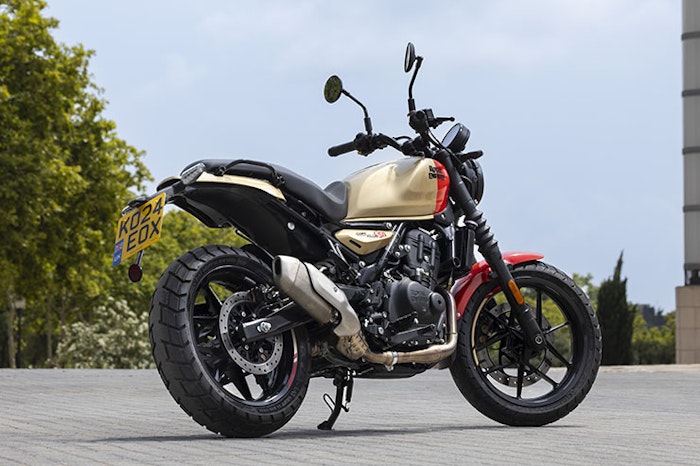
39.5bhp/29.5lb-ft
172kg
Triumph Speed 400 | Price: £5245
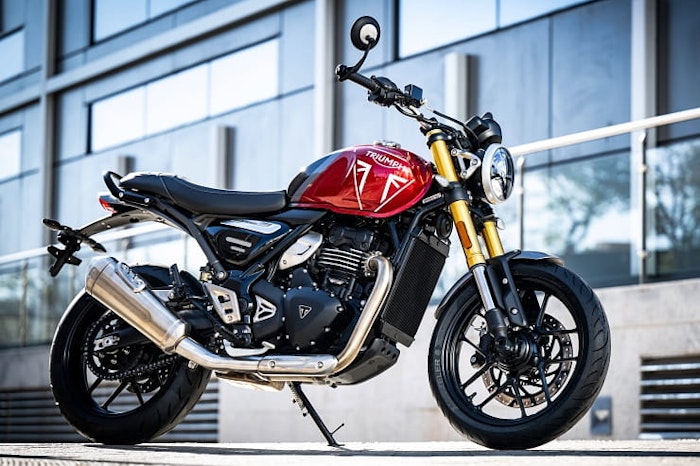
39.5bhp/27.7lb-ft
170kg

2026 Triumph Tracker 400 - Verdict
Triumph has already experienced success with the Speed 400 and Scrambler 400 models, so there’s little reason to believe the Tracker 400 will be any less popular. The real challenge for the British brand is to make sure it takes customers from rivals rather than sniping them away from its own stablemates. With good looks, slightly more performance than the already-popular Speed 400, and promising sharper handling, it should be another winner.
If you’d like to chat about this article or anything else biking related, join us and thousands of other riders at the Bennetts BikeSocial Facebook page.
Do you own a 400cc Triumph already? Tell us what it’s like, or ask us questions about it at bikeclub.bennetts.co.uk.

2026 Triumph Tracker 400- Technical Specification
| New price | From £5745 |
| Capacity | 398cc |
| Bore x Stroke | 89mm x 64mm |
| Engine layout | Single cylinder |
| Engine details | Liquid-cooled, 4 valve, DOHC |
| Power | 41.4bhp (30.89kW) @ 9,000rpm |
| Torque | 27.7lb-ft (37.5Nm) @ 7,500rpm |
| Transmission | 6-speed, chain final drive, slip/assist clutch |
| Average fuel consumption | 78.5 mpg claimed |
| Tank size | 13 litres |
| Max range to empty | 224 miles |
| Rider aids | Switchable traction control, ABS |
| Frame | Hybrid spine/perimeter, tubular steel, bolt-on rear subframe |
| Front suspension | 43mm upside down Big Piston forks. 140mm wheel travel |
| Front suspension adjustment | N/A |
| Rear suspension | Gas monoshock, external reservoir, 130mm wheel travel |
| Rear suspension adjustment | Preload only |
| Front brake | 300mm disc, four-piston ByBre radial caliper |
| Rear brake | 230mm disc, single piston sliding caliper |
| Front wheel / tyre | 110/70 R17 Pirelli MT60 RS |
| Rear wheel / tyre | 150/60 R17 Pirelli MT60 RS |
| Dimensions (LxWxH) | 2033mm x 857mm x 1050mm |
| Wheelbase | 1371mm |
| Seat height | 805mm |
| Weight | 173kg (wet) |
| Warranty | 2 years, unlimited miles |
| Servicing | TBC |
| MCIA Secured Rating | Not yet rated |
| Website | www.triumphmotorcycles.co.uk |

What is MCIA Secured?
MCIA Secured gives bike buyers the chance to see just how much work a manufacturer has put into making their new investment as resistant to theft as possible.
As we all know, the more security you use, the less chance there is of your bike being stolen. In fact, based on research by Bennetts, using a disc lock makes your machine three times less likely to be stolen, while heavy duty kit can make it less likely to be stolen than a car. For reviews of the best security products, click here.
MCIA Secured gives motorcycles a rating out of five stars (three stars for bikes of 125cc or less), based on the following being fitted to a new bike as standard:
A steering lock that meets the UNECE 62 standard
An ignition immobiliser system
A vehicle marking system
An alarm system
A vehicle tracking system with subscription
The higher the star rating, the better the security, so always ask your dealer what rating your bike has and compare it to other machines on your shortlist.

Getting a motorcycle insurance quote with Bennetts is easy.
We compare prices from our panel of top-tier insurers, to find riders our best price for the cover they need. With common modifications covered as standard, our policies are rated Excellent on Trustpilot and 5 stars by Defaqto. We are an award-winning UK broker, with a UK-based contact centre and 24/7 claims support.
Buy direct or renew at bennetts.co.uk, or via our contact centre, to gain access to a free BikeSocial Membership - unlocking discounts on kit, tyres, training, and exclusive customer-only VIP experiences.


