KTM 1390 Super Adventure S Evo (2025) - Review


BikeSocial Road Tester
19.01.2026


Technical Review: Ben Purvis (Oct 2024)
Riding Impressions: Adam ‘Chad’ Child (Jan 2026)


£18,699
170bhp
245kg (wet)
4/5
Motorcycling doesn’t get much more high-tech than this: KTM’s 2025 1390 Super Adventure S Evo sports not only the latest generations of semi-active suspension and radar-operated adaptive cruise control but also debuts the company’s first automated gearbox (AMT) – all packed into the world’s most powerful showroom adventure bike.
That might sound like hyperbole but, on paper at least, the KTM 1390 Super Adventure S Evo really does have it all, from near-superbike performance to technology that promises to make riding both easier and safer than ever before. Whether that’s enough to sway riders away from the default choice in the big adventure market – the BMW R 1300 GS – remains to be seen, but KTM can’t be accused of making a half-hearted effort.
Despite the world being introduced to this model back in October 2024, KTM’s since had its own issues to sort and so the bike was held back by 12 months, so we ask has this superfast, tech-heavy adventure bike been worth the wait?
Pros & Cons
KTM’s AMT transmission promises remarkable ease-of-use
Latest-gen radar introduces stop-and-go adaptive cruise control for heavy traffic
New 1390 LC8 V-twin brings substantial performance boost, especially mid-range
iPad-style touchscreen dash, which is easy to navigate
4-year warranty
If you want a back-to-basics ride, this isn’t for you
No self-levelling suspension unlike some rivals
Heated grips are not standard
Some won't like to pay extra for the ‘Demo Mode.’
No rear radar, front only.


2025 KTM 1390 Super Adventure S Evo - Price & PCP Deals
Again, despite the model’s announcement more than a year before we got to ride it, the final price was also held back. All this tech and market leading power, prices start at ‘just’ £16,999 for the standard Super Adventure S, and £18,699 for the Evo model. As tested, we also had the additional Tech Pack (£905.20) which, should you decide to keep after the ‘demo’ period or around 1500km, raises the price to just under £20,000.
A sample finance deal looks like this:


2025 KTM 1390 Super Adventure S Evo - Engine & Performance
The engine in the 1390 Super Adventure S Evo is KTM’s ‘1390’ LC8 V-twin, which debuted in the 1390 Super Duke R and is sure to spread through the range as a replacement for the previous ‘1290’ motor.
Those numbers aren’t representative of precise capacity. The ‘1290’ engine actually measures 1301cc and the new ‘1390’ comes in at 1350cc, so there’s only a 49cc moped’s worth of capacity increase between the generations. The performance boost, however, is much more than a moped’s-worth. Where the old 1290 Super Adventure S managed 118kW – that’s a respectable 158hp – the new 1390 manages 170hp, or 173PS to use KTM’s favoured mode of measurement. It’s down compared to the 188hp of the engine in the 1390 Super Duke R, but still enough to reestablish KTM’s Super Adventure as the most powerful standard adventure bike, just eclipsing the Ducati Multistrada V4.
The disproportionate power hike is courtesy not just of the extra cubes but the addition of variable valve timing and lift on the intake camshaft, using a ‘Camshift’ system that works in essentially the same way as BMW’s ShiftCam setup. The maximum power arrives at 9500rpm, with peak torque of 145Nm (107lbft) at 8000rpm.
However, it’s the transmission that’s the KTM’s real talking point. KTM’s new ‘AMT’ (automated manual transmission) is a rival to the likes of Honda’s DCT, Yamaha’s Y-AMT and of course BMW’s ASA, but it operates a little differently to any of them.
While DCT is in a league of its own, with dual clutches and essentially two transmissions in one, the BMW and Yamaha designs are both automated versions of conventional manual boxes, with electromechanical actuators replacing your left hand and left foot when it comes to operating the clutch and shifter.
KTM has gone its own route, introducing an actuator to rotate the shift drum but opting against an electromechanical clutch. Instead, it has a scooter-style centrifugal clutch that automatically disengages at low rpm. That means to get going, you simply put it in gear and twist the throttle, and when you stop, the engine can’t stall.
On the move, the servo-operated shifter works in harmony with the engine electronics to provide lightning-fast shifts – sub-50-milliseconds – without the need for electronic control of the clutch. The system’s design means that it’s impossible to leave the bike in gear when parked to stop the rear when from turning – the clutch will be disengaged – so KTM has added a locking pawl into the transmission, and a ‘Park’ setting along with Neutral and the six gear ratios, to allow the transmission to be locked when the bike is sitting. That should make it that much harder to steal, too, as without the key a thief won’t be able to simply wheel it away.
The AMT offers two modes: auto or manual. Twist the throttle and it rolls away like a big scooter, using a centrifugal clutch. Revs climb to around 1,800–1,900rpm before the wheels turn. There’s no clutch lever, no biting point, which feels odd at first, but pulling away is smooth and quickly becomes natural. You can’t stall it, and stopping is effortless because, well, there’s no clutch to think about. Just ride and let the gearbox get on with it.
Shifts are generally smooth, and because it’s linked to the IMU, it won’t change gear mid-lean. Push harder, though, and I found myself intervening more - short-shifting or dropping a gear for engine braking. At a proper pace, I preferred manual mode, using the familiar foot shifter and having full control. #OldSchool
Ride it hard, and I never quite gelled with auto, even in Sport. The V-twin has so much torque you can short-shift and still attack, but Auto Sport hangs onto gears too long, revs too high, and feels jerky, especially down low. That just makes the suspension, tyres, and electronics work harder than they need to.
For relaxed riding, though, the AMT is easy, slick, and genuinely beneficial. Dropping a gear by rolling the throttle past the natural closed position is addictively entertaining. Personally, I’d save the money and go manual with the quickshifter - it makes the clutch almost redundant anyway. And as a shorter rider, I still miss having a clutch for balance at walking pace and tight manoeuvres.


2025 KTM 1390 Super Adventure S Evo - Handling & Suspension (inc. Weight)
The previous 1290 Super Adventure S already used KTM’s semi-active suspension, and the 1390 Super Adventure S Evo ups the game with an even more advanced version of the system. KTM says that the latest version of the setup uses new Pulse Width Modulation sensors and a through-rod fork design that combines elements of both open cartridge and closed cartridge systems. The forks themselves are vast 48mm upside-downers, and thanks to the semi-active system you’ll be able to adjust them and the matching WP rear shock via the (new, bigger) touchscreen dash.
Brembo provides the brakes, as before, with 4-pot radial calipers at the front and a two-piston one at the rear, with cornering ABS as standard. The brakes are also tied into the brake assistance system that comes with the 1390 Super Adventure S Evo’s front-facing Bosch radar. KTM claims a wet weight, including a full, 23-litre tank of fuel, of 245kg, or 228kg when measured without fuel. That’s a single kilo more than the old 1290 Super Adventure S.
Like the AMT, WP’s SAT suspension is tied to the ride modes: Sport, Street, Comfort and Rain. Each mode has a clear effect on how the 1350 feels, but even Comfort mode isn’t wallowy. It’s plush for touring yet firms up when you crack the throttle. Sport adds real stability and support, and the anti-dive keeps the 220mm forks in check under hard braking.
Ground clearance is excellent, even in Comfort with extra sag, and the new Dunlops cope well with hard road riding. That said, you’re always aware it’s a 19-inch front adventure bike. Steering isn’t heavy, but it’s not as sharp or agile as a Multistrada V4S or R1300GS on road tyres.
The adjustable ABS works well, though it’s not as crisp as the Italian and German setups. That might be down to relying on the brakes more, thanks to reduced engine braking in auto mode. Front and rear brakes aren’t linked, rear ABS can be switched off, but without a clutch, backing it in supermoto-style is extremely difficult - bordering on impossible. Not exactly a deal-breaker though!


2025 KTM 1390 Super Adventure S Evo - Comfort & Economy
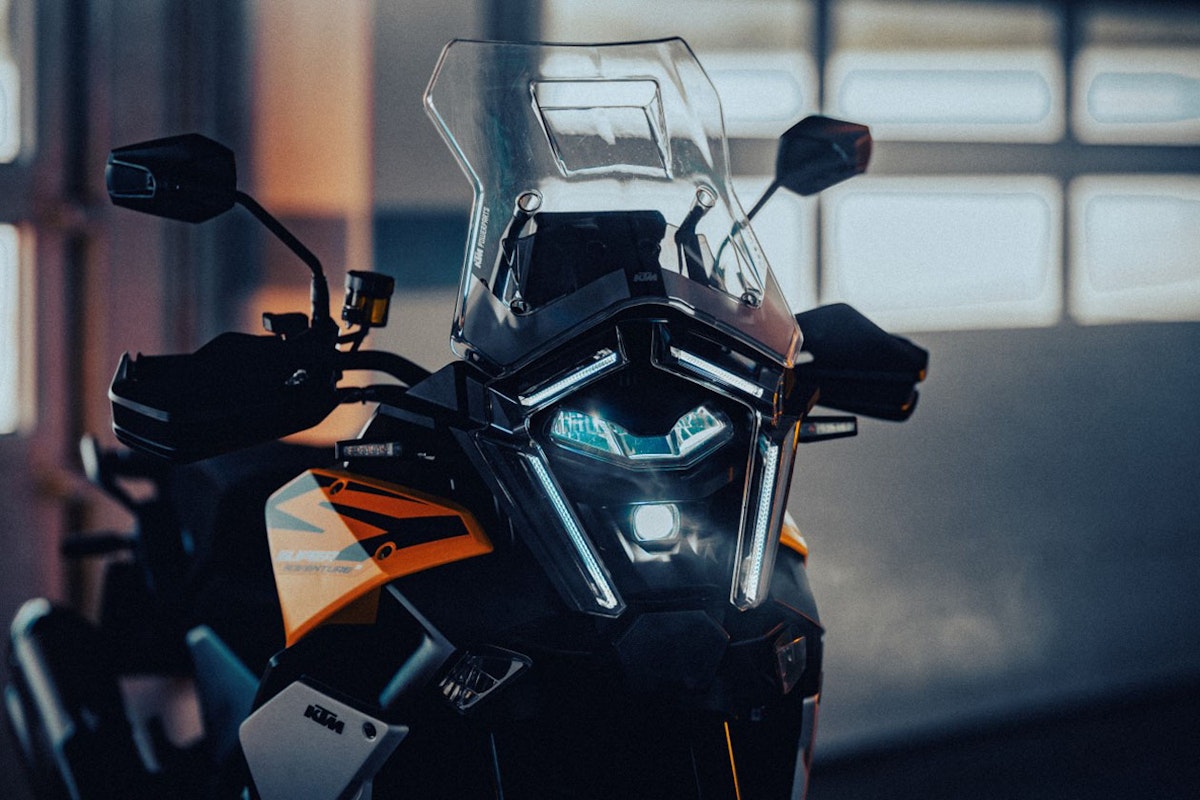
The pegs are 8mm lower and 10mm wider-spaced than before, making for a more spacious riding position, and the new bodywork includes a reshaped windscreen, new headlight and a new storage compartment. The semi-auto transmission also promises to reduce stress and strain on longer rides, handling shifts on your behalf, and the radar-assisted cruise control is yet another element to take some of the effort away.
Fuel economy, according to official figures, comes in at 42.16mpg. That’s not exactly sipping, but this is a big, powerful, heavy bike. With a vast 23-litre tank, you should still be able to eke out a theoretical 213 miles from brimmed to bone dry.
Most riders will settle into the Super Adventure’s comfort zone, let the auto ’box do its thing and knock out serious miles - exactly what this KTM is built for. Wind the screen up (now with 70mm of adjustment), set the cruise - manual or adaptive - follow the excellent integrated sat-nav and just ride.
Wind protection is superb and the riding position is roomier with wider bars and lower pegs, and more space overall. The huge dash is endlessly engaging and the 23-litre tank, (the biggest in the standard adventure class) backs up its mile-munching credentials. I saw 39mpg riding briskly, which translates to around 200 miles and more before you start thinking about fuel.
Practical touches seal the deal: multiple USB-C ports, a handy tank-top phone compartment, and even a proper old-school toolkit under the seat.


2025 KTM 1390 Super Adventure S Evo - Equipment
We’ve already covered the semi-active suspension and the automated-manual transmission but the new KTM 1390 Super Adventure S Evo still has plenty of extra kit to delve into.
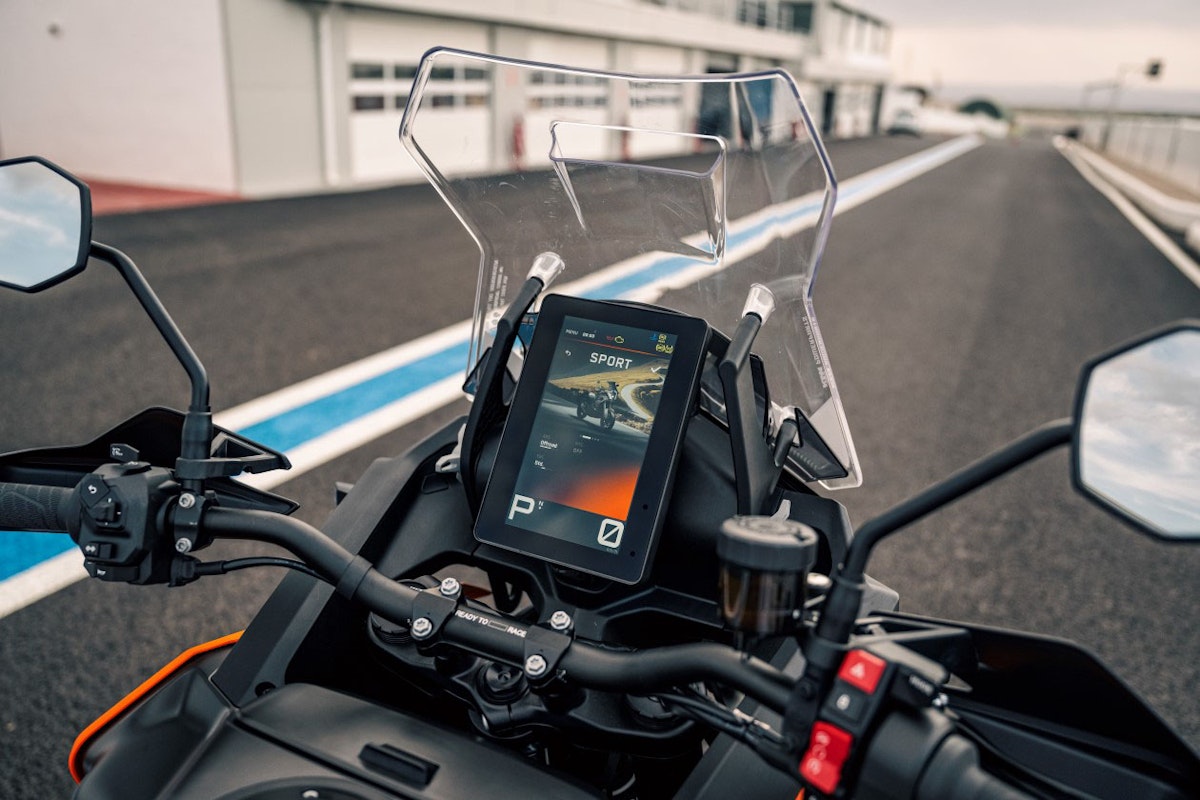
This leads off with the first example of KTM’s new ‘V80’ TFT dashboard. Able to display more colours than previous designs, the V80 is a portrait-oriented, 8” touchscreen, so it’s like having a tablet in front of you to access all the bike’s tech, including the riding modes, suspension settings and the latest adaptive cruise control.
This is the next of the bike’s party-pieces. Powered by a fifth-generation Bosch radar, the system offers the usual ability to monitor the traffic in front and keep pace with it at a safe distance but adds more functions including ‘Dynamic’ and ‘Street’ settings, plus a ‘Group Ride’ mode designed to be used when, as the name suggests, you’re in convoy with other bikes.
The AMT gearbox helps expand the system’s abilities, too. Since the bike can shift its own gears and come to a halt without needing you to pull in a clutch, the radar-assisted adaptive cruise control can now operate all the way down until you come to a halt, with its new ACC Stop & Go function. Like the ACC systems on many modern cars, it will brake gently to a halt if the traffic ahead stops, and if it starts to move again in less than three seconds, the ACC automatically gets going again. Stops longer than three seconds require a rider input in the form of a slight tweak of the throttle or a touch of the ‘resume’ button to get going again.
Your eye is immediately drawn to the huge, iPad-like touchscreen dash and the illuminated switchgear. Both are intuitive and easy to use. KTM’s 990 RC R has a similar setup, but this is a step up - bigger, clearer, and genuinely usable with gloves on.
There’s a lot going on, but it’s all well laid out, colour-coded, and easy to read. You can zoom in and out like a smartphone, choose exactly how much information you want on display, and if you get lost, there’s a big, idiot-proof home button to reset everything.
Modes can be changed via the screen or a button on the right bar. Other menus are accessed through the touchscreen or the backlit joystick on the left, so you don’t need to take a hand off the bars. Best of all, everything can be switched off. Don’t want radar cruise? Turn it off. Same for traction control or the hazard warning system. And once you’ve set it your way, it stays that way, your settings are saved.
2025 KTM 1390 Super Adventure S Evo - Rivals
The big adventure bike market is as competitive as ever, so the KTM has some serious rivals to beat including the newly updated Ducati Multistrada V4 and BMW’s still-fresh R1300GS – now one of the few to also include its own semi-auto transmission. And don’t forget Triumph’s Tiger 1200, too.
BMW R1300GS ASA | Price: £20,695 (with radar)

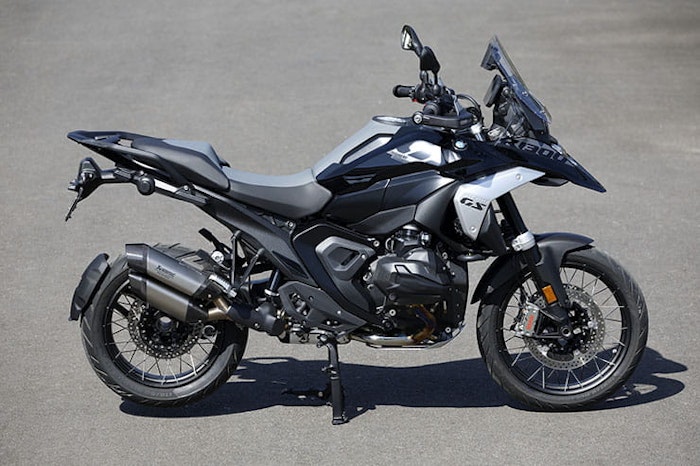
143bhjp / 110lb-ft
237kg
Ducati Multistrada V4 S | Price: £22,495 (with radar)


168bhp / 91.5lb-ft
232kg
Triumph Tiger 1200 GT Explorer | Price: £18,695
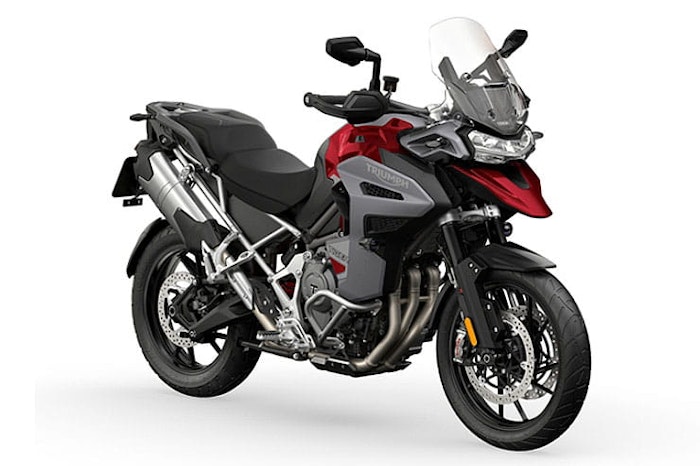
148bhp / 96lb-ft
256kg

2025 KTM 1390 Super Adventure S Evo - Verdict
Comparing the KTM on price is tricky because spec varies so wildly across the class. This isn’t apples with apples. The KTM has a class-leading dash but skips rear radar and an auto-lowering shock, while arguably offering more off-road-focused rider aids.
What’s not up for debate is performance. It’s the most powerful bike in the class, with a huge slab of usable, drivable torque. It’s a clear step on from the 1290, thanks to improvements across the board, chassis, suspension, tyres, electronics, and comfort.
The 8” dash is genuinely world-class, and the semi-active suspension and handling are right up there with the competition. True to KTM form, it’s engaging and fun to ride - and being orange, you’d expect it to work when the tarmac ends. Sadly, there wasn’t an off-road element to this test.
Heated grips should really be standard, but you do get a centre stand. Service intervals are long, the fuel tank is the biggest in class, and there’s a four-year warranty as standard.
I’d stick with the manual gearbox and quickshifter. As a shorter rider, I miss the option of a self-lowering shock, and I’m unsure if it should have a rear radar like the competition. The demo mode for rider aids won’t suit everyone either, but these are minor, personal gripes.
This is a hugely impressive, genuinely versatile adventure bike happy to pull your arms straight with its effortless torque, yet just as content pottering through town or tearing up a twisty road. KTM has a serious contender for top dog in the big-adventure class and for under £20,000.
If you’d like to chat about this article or anything else biking related, join us and thousands of other riders at the Bennetts BikeSocial Facebook page.
Do you own a KTM adventure bike? Tell us what it’s like, or ask us questions about it at bikeclub.bennetts.co.uk.


2025 KTM 1390 Super Adventure S Evo - Technical Specification
| New price | From £18,699 |
| Capacity | 1350cc |
| Bore x Stroke | 110 x 71mm |
| Engine layout | V-twin, 75-degree |
| Engine details | DOHC, 8-valve, Camshift, liquid-cooled |
| Power | 170bhp (127kW) @ 9500rpm |
| Torque | 107lb-ft (145Nm) @ 8000rpm |
| Transmission | 6 speed, AMT (automated manual transmission) |
| Average fuel consumption | 42.16mpg claimed |
| Tank size | 23 litres |
| Max range to empty | 213 miles |
| Rider aids | Cornering traction control with 4 modes, cornering ABS with 3 modes, MSR, Engine Brake Control |
| Frame | Chromoly steel trellis frame |
| Front suspension | WP SAT semi active upside-down forks, 48mm |
| Front suspension adjustment | Fully adjustable, semi-active |
| Rear suspension | WP SAT semi-active shock |
| Rear suspension adjustment | Fully adjustable, semi-active, electronic preload |
| Front brake | 2 x Brembo 4-piston, radially mounted caliper, 320mm disc |
| Rear brake | Brembo 2-piston caliper, 267mm disc |
| Front wheel / tyre | Cast aluminium wheel, 3.50 x 19", Dunlop Meridian 120/70 ZR 19 |
| Rear wheel / tyre | Cast aluminium wheel, 5.00 x 17", Dunlop Meridian 170/60 ZR 17 |
| Dimensions (LxWxH) | TBA |
| Wheelbase | 1558mm ± 15mm |
| Seat height | 847/867 mm |
| Weight | 245kg (kerb) |
| Warranty | 4 years |
| Servicing | Standard oil changes and inspections still occur annually or every 9,300 miles, whichever comes first. |
| Valve clearances are c.37,000-miles | Not yet rated |
| MCIA Secured Rating | Not yet rated |
| Website | www.ktm.com |

What is MCIA Secured?
MCIA Secured gives bike buyers the chance to see just how much work a manufacturer has put into making their new investment as resistant to theft as possible.
As we all know, the more security you use, the less chance there is of your bike being stolen. In fact, based on research by Bennetts, using a disc lock makes your machine three times less likely to be stolen, while heavy duty kit can make it less likely to be stolen than a car. For reviews of the best security products, click here.
MCIA Secured gives motorcycles a rating out of five stars (three stars for bikes of 125cc or less), based on the following being fitted to a new bike as standard:
A steering lock that meets the UNECE 62 standard
An ignition immobiliser system
A vehicle marking system
An alarm system
A vehicle tracking system with subscription
The higher the star rating, the better the security, so always ask your dealer what rating your bike has and compare it to other machines on your shortlist.

Getting a motorcycle insurance quote with Bennetts is easy.
We compare prices from our panel of top-tier insurers, to find riders our best price for the cover they need. With common modifications covered as standard, our policies are rated Excellent on Trustpilot and 5 stars by Defaqto. We are an award-winning UK broker, with a UK-based contact centre and 24/7 claims support.
Buy direct or renew at bennetts.co.uk, or via our contact centre, to gain access to a free BikeSocial Membership - unlocking discounts on kit, tyres, training, and exclusive customer-only VIP experiences.


